
Third General Meeting
University of Zagreb
Faculty of Electrical Engineering and Computing (FER)
Unska 3
10000 Zagreb
Croatia
24–25 February 2026
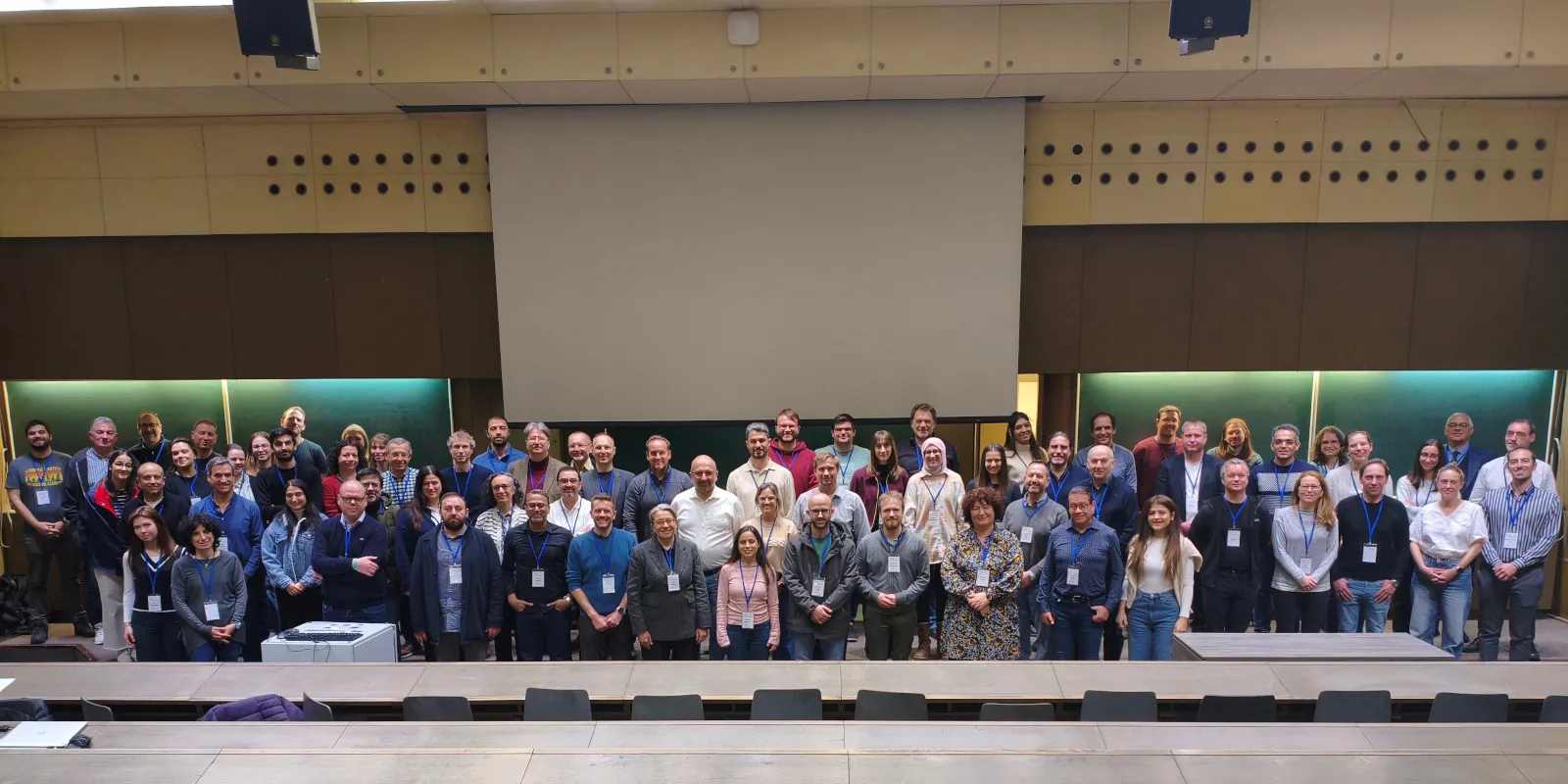
About the meeting
The meeting comprised an Action Workshop and a general Working Group meeting. The Action Workshop on the first day was devoted to advances in optimisation solvers, performance, and usability aspects, including algorithm configuration, solver availability, and workflow integration. The programme featured invited presentations by providers of optimisation software, industry end users, and Randomised Optimisation Algorithm (ROA) researchers, followed by a panel discussion on challenges and opportunities for ROA solvers in the real world. The second day consisted mainly of break-out meetings of the various Working Groups.
Programme
Tuesday, 24 February 2026 – Workshop
09:00 – 09:30 | Welcome Chair: Domagoj Jakobović, Local Organiser |
About ROAR-NET Carlos M. Fonseca, Action Chair | |
09:30 – 10:30 | Oral presentations Chair: Francesca Da Ros, WG1 Member |
The ROAR-NET API: Current status and future directions Carlos M. Fonseca, University of Coimbra, Portugal | |
Challenges in modelling and solving real-world maritime logistics problems Alexandre Jesus, A.P. Moller - Maersk, Portugal AbstractMaritime logistics problems exhibit substantial complexity, arising from multi-objective formulations, tightly coupled operational constraints, and large combinatorial decision spaces, which makes these problems hard to solve to optimality. In addition, incomplete and uncertain data is also often present and impacts both objective functions and constraints. For example, uncertainty in weather and tidal forecasts can affect objectives and constraints that depend on sailing times, speed restrictions, and fuel-consumption models. Moreover, the interactions between navigational, operational, and customer-driven requirements, compounded by uncertainty factors, often make solver-generated decisions difficult for human decision makers to interpret, limiting trust and adoption. In this talk, I will examine these challenges through two real-world problems in berth allocation and vessel scheduling, and discuss what features in modelling and solver software can meaningfully impact the development of decision-support systems in real-world applications. | |
10:30 – 11:00 | Coffee break |
11:00 – 12:30 | Oral presentations Chair: Özlem Karsu, Action Vice-Chair |
Combining metaheuristics and exact programming via GAMSPy Hamdi Burak Usul, GAMS, Germany AbstractIn this presentation, we explore the integration of heuristic methods with exact mathematical optimization. While heuristics offer robust performance across diverse real-world applications, specific problems often present complexities that require the precision of exact solvers. We demonstrate how GAMSPy, the Python interface for GAMS, facilitates these hybrid workflows. Specifically, we showcase methodologies for utilizing heuristics as standalone solvers or as components within a larger framework. | |
Hexaly, a new kind of global optimization solver Thierry Benoist, Hexaly, France AbstractHexaly Optimizer is a new kind of global optimization solver. Its modeling interface is nonlinear and set-oriented. In a sense, Hexaly APIs unify and extend modeling concepts from mixed-linear programming, nonlinear programming, and constraint programming. Under the hood, Hexaly combines various exact and heuristic optimization methods, such as branch-and-bound, automatic Dantzig-Wolfe reformulation, column and row generation, propagation methods, local search, direct search, and surrogate modeling techniques. Regarding performance benchmarks, Hexaly distinguishes itself against the leading solvers in the market, like Gurobi, IBM Cplex, and Google OR Tools, by delivering fast and scalable solutions to Routing, Scheduling, Packing, Clustering, and Location problems. This talk will introduce our set-based modeling formalism and show its scalability for large instances. We will then explore how the solver can use this formalism to automatically use state-of-the-art resolution techniques from the exact and heuristic fields. | |
modeFRONTIER: Orchestrating simulation automation and design optimization through a democratized user experience Mariapia Marchi, ESTECO SpA, Italy AbstractThis presentation provides a high-level overview of modeFRONTIER, the desktop solution by ESTECO for engineering simulation process automation and continuous design optimization. We will explore the core capabilities that define the tool, including its robust workflow integration and seamless interoperability with multidisciplinary software tools, an enhanced user experience to democratize optimization, and an optimization-driven design approach, also leveraging on AI/ML for faster data-driven insights. | |
12:30 – 14:30 | Lunch |
14:30 – 16:00 | Oral presentations Chair: Denis Pallez, WG1 Vice-Leader |
Modelling the clique partitioning problem under the ROAR-NET API Andreia P. Guerreiro, INESC-ID, Portugal AbstractThe ROAR-NET API defines an interface for modelling optimisation problems that allows a wide range of randomised optimisation algorithms to be used to approach such problems in a black-box manner. The API abstracts the exploration of the search space in terms of neighbourhood structures, where the relation between neighbouring solutions is described in terms of the application of small changes called moves. The clique partitioning problem is a combinatorial optimisation problem where the goal is to partition the set of vertices of a weighted undirected graph so as to maximise the total weight of the internal edges of the resulting subgraphs. This talk demonstrates how the clique partitioning problem can be modelled under the ROAR-NET API. In particular, the definition and implementation of different construction rules and local-search neighbourhood structures, and of the corresponding moves, are discussed. | |
A multi-neighborhood, lexicographic local search algorithm for the Integrated Healthcare Timetabling Competition 2024 Ahmad Othman, Jeppesen ForeFlight, Denmark AbstractThe Integrated Healthcare Timetabling Competition 2024 (IHTC-2024) focused on a problem formulation that integrates three problems arising in healthcare timetabling: patient admission scheduling, operating theater planning and nurse-to-room assignment. Out of 32 entries to the competition, our solver ranked second in the overall category and first in the open source category. Our solver builds on the ROAR-NET API specification without sacrificing efficiency and flexibility. It consists of a solution representation that implicitly satisfies a few feasibility (hard) constraints and a classical local search approach that uses multiple, small-scale neighborhoods to address the different decision tasks. The solver deals with both feasibility and optimality (soft) constraints at once thanks to a lexicographic multi-objective formulation that lends itself to lazy evaluations. The search strategy is a hybrid metaheuristic that shares the run-time between simulated annealing for exploration and iterated local search for exploitation. To take advantage of the 4-threads made available by the rule of the competition, we selected, offline, a set of four parameter configurations by solving optimally a sequence of set covering problems with cardinality restrictions. In the final algorithm, these four configurations run independently in parallel, and the best solution found amongst them is selected. | |
Building a company based on randomised optimisation algorithms Goran Molnar, Dots & Lines, Croatia AbstractThe area of randomised optimisation algorithms has achieved numerous breakthroughs and advances. These techniques have been successfully applied to difficult problems, and the research and engineering effort continues to expand the frontier of what can be successfully solved. Nevertheless, the real-world applications still carry specific undesirable characteristics. Their development is costly and time-consuming, requiring highly educated experts and substantial computational resources. Once a real-world problem is solved, users regularly demand changes that further complicate already complex algorithms. In this lecture, the presenter will outline efforts to reconcile two very different worlds: academia and the software industry. The lecture will address the specific challenges of working toward scientific publication versus delivering a high-quality software product. How can scientific results be successfully communicated to clients who may not have a technical background? What are the ethical challenges that arise when building an optimisation product? What are the needs of the software industry that academia could help with? In addition to scientific and technical topics, specific business challenges of launching a company, the specifics of using open-source solvers, and selling optimisation software will also be discussed. | |
16:00 – 16:30 | Coffee break |
16:30 – 17:30 | Panel discussion Moderator: Carlos M. Fonseca, Action Chair Panelists
|
17:30 – 18:00 | Close |
Wednesday, 25 February 2026 – Working Group meeting
09:00 – 09:15 | Welcome |
09:15 – 10:30 | Break-out sessions |
WGs 1 and 3 – Multiobjective optimisation and preference articulation support in the ROAR-NET API Moderator: Marco Chiarandini, WG1 Member | |
WG2 – Randomised and hybrid methods for mixed numerical-combinatorial optimisation Moderators: Ofer M. Shir and Nazlı Tekin, WG2 Members | |
WG4 – Optimisation under uncertainty Moderators: Per Kristian Lehre, WG4 Leader, and Michael Hellwig, WG4 Vice-Leader | |
WG5 – Algorithm selection and configuration Moderator: Elena Raponi, WG5 Member | |
WG6 – Benchmarking Moderator: Boris Naujoks, WG6 Leader | |
ROAR-NET grants: From application to report Moderators: Bogdan Filipič, Grant Awarding Coordinator, Işıl Öz, Gender Equality Adviser, and Özlem Karsu, Action Vice-Chair | |
10:30 – 11:00 | Coffee break |
11:00 – 12:15 | Break-out sessions |
WG1 – Visualisation of optimisation results Moderator: Mariapia Marchi, WG1 Member | |
WG2 – Unified modelling and structural analysis of mixed continuous-discrete search spaces Moderators: Valentino Santucci and Rita Arfoul, WG2 Members | |
WG3 – Problem characteristics in multiobjective applications Moderator: Sunith Bandaru, WG3 Member | |
WG4 – Optimisation under uncertainty Moderators: Per Kristian Lehre, WG4 Leader, and Michael Hellwig, WG4 Vice-Leader | |
WG5 – Algorithm selection and configuration Moderator: Elena Raponi, WG5 Member | |
WG6 – Benchmarking Moderator: Boris Naujoks, WG6 Leader | |
Science communication Moderator: Ekhiñe Irurozki, Science Communication Coordinator | |
12:15 – 14:15 | Lunch |
14:15 – 15:30 | Break-out sessions |
WGs 1 and 3 – Workflow integration and interaction with the optimisation process Moderator: Carlos M. Fonseca, Action Chair | |
WG2 – Unified modelling and structural analysis of mixed continuous-discrete search spaces Moderators: Valentino Santucci and Rita Arfoul, WG2 Members | |
WG4 – Optimisation under uncertainty Moderators: Per Kristian Lehre, WG4 Leader, and Michael Hellwig, WG4 Vice-Leader | |
WG5 – Algorithm selection and configuration Moderator: Elena Raponi, WG5 Member | |
WG6 – Benchmarking Moderator: Boris Naujoks, WG6 Leader | |
Pushing the ROAR-NET GitHub organisation forward: Governance, collaboration, and promotion Moderator: Alexandre Jesus, Software Development Coordinator | |
15:30 – 16:00 | Coffee break |
16:00 – 18:00 | Plenary presentations and discussion |